Luna Moth (Actias luna) – Complete Care Guide
The Luna Moth (Actias luna) is one of the largest and most iconic North American silkmoths, known for its pale green wings and graceful flight. Despite their exotic appearance, Luna Moths are surprisingly easy to rear when given the correct host plants and conditions. This guide covers everything you need to know to care for Luna Moth eggs, caterpillars, cocoons and adults.
Luna Moth Pair
This beautiful pair of luna exhibits a yellowish male (L) and pale blue female (R). Colouration can vary in shades of pale green, with the spring brood exhibiting red margins around the wing edges.
Egg Care
Luna Moth (Actias luna) eggs should be kept in a closed plastic container to prevent them from drying out. Eggs are typically blue-grey and maintain a consistent colour throughout development.
Excess moisture can drown the embryo or cause mould, which can kill developing larvae.
Avoid adding host plant leaves before hatching - fresh leaves release moisture and often cause eggs to mould.
Left alone in their container, at room temperature and out of direct light, eggs hatch within 10-14 days of the date of them being laid.
Caterpillar Care
Host Plants for Actias luna
Luna Moth caterpillars feed on a variety of broad-leaved trees. The best host plants include:
- Birch (Betula)
- Osier Willow (Salix viminalis)
- Alder (Alnus)
- Sweet Gum (Liquidambar)
- Walnut (Juglans)
These hosts are widely available and support strong larval development.
.
Caterpillar Care
Once the caterpillars hatch:
- Move them by hand or using a soft paint brush to a separate container
- Do not add foliage to the egg container due to the risk of mould
Luna caterpillars grow quickly and can reach a large size when provided with nutritious host plants. Under normal conditions, the larval stage lasts approximately 4–5 weeks.
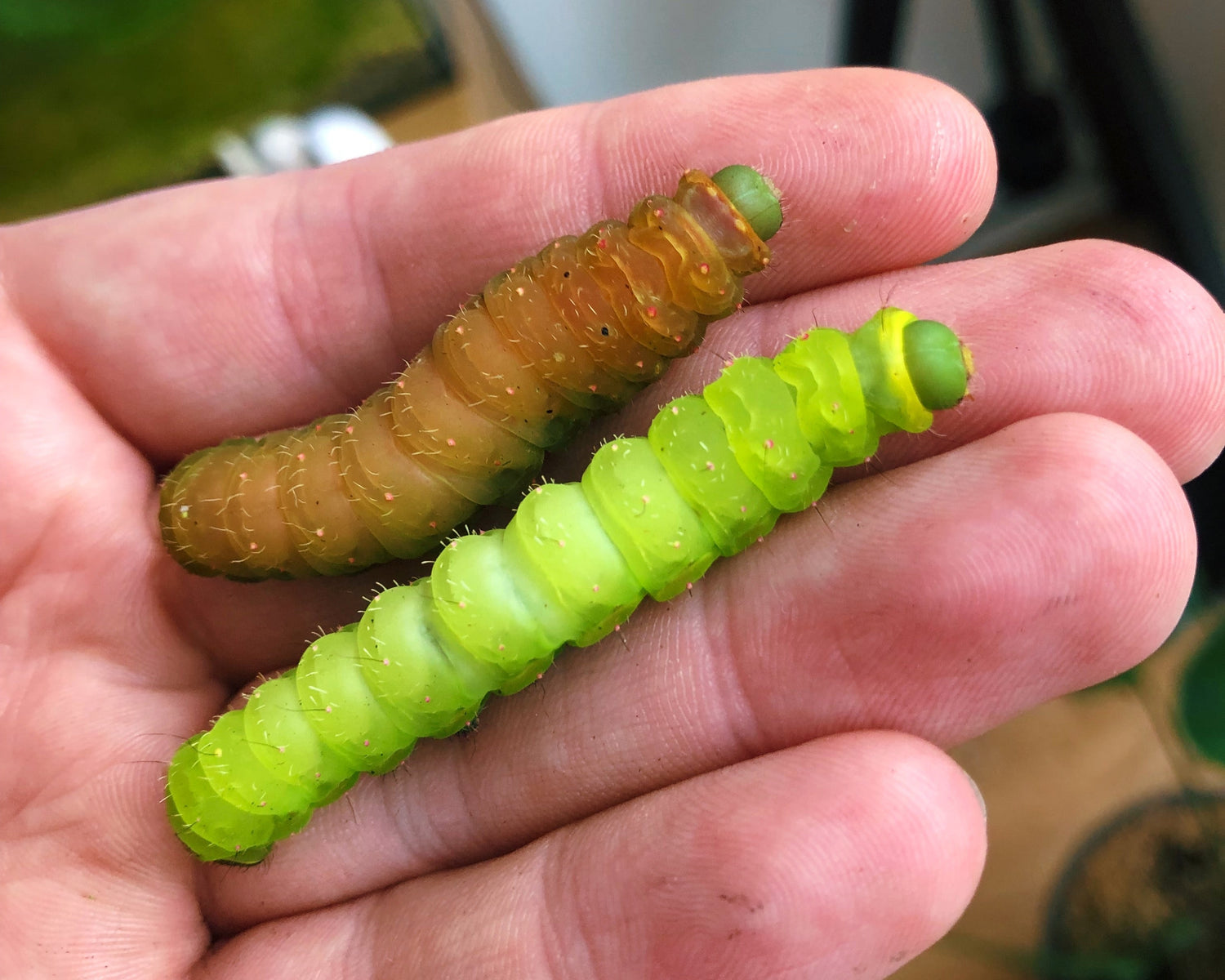
Final Instar Larvae
These two larvae are in the fifth instar and nearly ready to pupate - the orange/brown one has begun to search for a pupation site and will shortly begin to construct a cocoon.
Pupation & Cocoon Care
When fully grown, Luna caterpillars will look for a sheltered area to spin their cocoon. They typically attach the cocoon:
- Among the leaves or twigs of their host plant
- Against branches, or
- Directly to enclosure surfaces
Inside the cocoon, the caterpillar becomes immobile and sheds its final skin to form the pupa. The cocoons are robust and can be easily handled if you need to remove them from the rearing cage.
.
Cocoon Stage
- Cocoons can remain where they were spun unless you need the enclosure for other species.
- Spring and summer cocoons normally emerge within 2–4 weeks - keep these at room temperature and mist daily to ensure they emerge successfully.
- Late summer/autumn cocoons will usually overwinter and emerge the following spring - store these in a fridge (most reliable) or garage/shed over the winter.
Following our care guide for pupae and cocoons will provide the best results.
Adult Luna Moth Care
Adult Luna Moths require minimal care, as they do not feed - their mouthparts are vestigial. Their primary purpose is breeding, but this can be avoided by separating males and females if you would prefer not to produce another generation.
.
Housing Adults
- Provide a spacious mesh enclosure
- A 60 cm cage is suitable for up to 10 adults
- A 90 cm enclosure is ideal for larger groups
Adults need only:
- Space to fly
- Air flow for mating
Luna Moths live only a few days as adults, and all their energy comes from what they stored during the caterpillar stage. The lifespan can extend to a couple of weeks in some instances, but about 7 days is average. Each female can lay more than 200 eggs during this time.