Caring for Eggs & Caterpillars
Most butterfly and moth species that are commonly bred in captivity are pretty straightforward to care for if you are equipped for them. This guide explains the fundamental steps in caring for your eggs through the hatchling and caterpillar stage and into pupation.
Egg Care
Generally, eggs should be kept in an airtight plastic container to prevent them drying out - this keeps the environment stable and insulates the eggs from fluctuations in temperature and humidity.
Open the container once per day to avoid it becoming stagnant - you can also add moisture by gently breathing into the container through a small gap.
Eggs are typically round but the actual shape varies by species, with some being elongated or having one flat side. An indent in the egg can be normal, however a totally collapsed egg indicates it is infertile or has died.
Important egg-care tips
- Keep eggs in a closed plastic container
- Keep at room temperature
- Do not add leaves before hatching — fresh leaves release moisture and can cause mould, which easily kills eggs.
Blue Morpho hatchlings
Young Morpho larvae which have just hatched and consumed their egg shell as their first meal!
Caring for Hatchlings
When your eggs start to hatch, set up a new plastic container and line it with tissue paper. Lay out some host plant foliage for larvae to feed on - remember that each species has its own host plant(s). Some species accept only one plant whilst others accept many!
Move the hatchlings from the egg container to the new container using your finger or a fine, soft paint brush (whichever you are more confident using). A paint brush is typically easier, particularly for smaller species.
Stages of development
Caterpillars reveal a new skin at every shed - often changing colour at different stages - illustrated by these fourth and fifth stage swallowtail larvae.
Caterpillar Development & Care
Most caterpillars go through five stages, known as instars or by the abbreviation L (level) 1 to 5. Some larger species go through multiple, such as Attacus atlas which has 6 or Automeris metzli with 7 stages.
It is common for caterpillars' appearance to change between instars, often in colour and sometimes losing or gaining tubercles and other adornments.
Maintain caterpillars in plastic containers for the first two or three stages when they are most delicate, as it continues to keep steady conditions.
Once they reach the third or fourth instar, it is usually a good idea to move the caterpillars to mesh enclosures. This is because they provide optimal air circulation which reduces the incidence and spread of disease among larvae - a common issue when larvae are kept in plastic containers for too long.
In mesh enclosures, provide fresh host plant material in glass vases or jars, covering any holes that larvae could fall through into water. Replace either when the foliage wilts or when the caterpillars have consumed it all.
Mature larvae
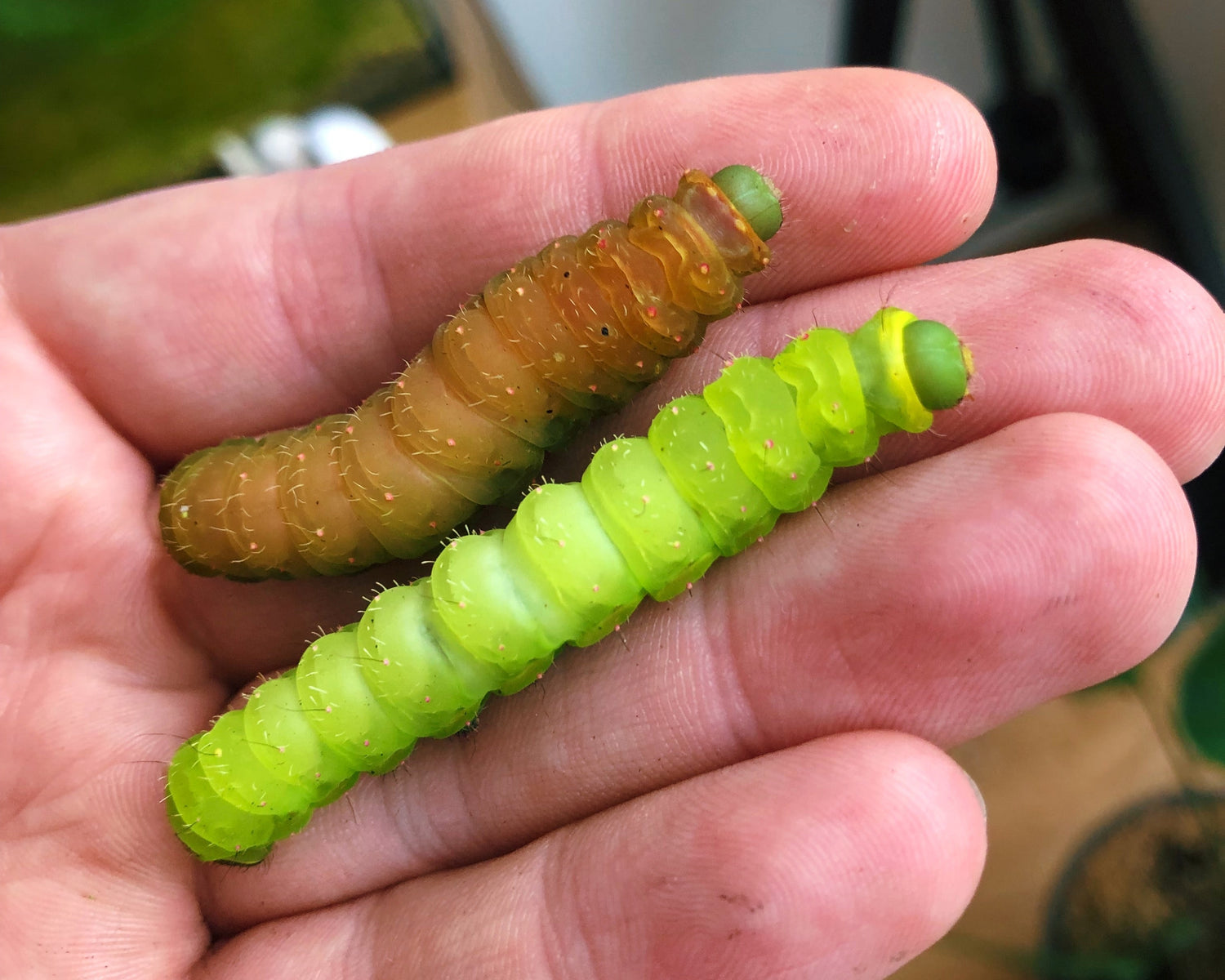
These luna moth (Actias luna) caterpillars are fully grown, the upper one has turned orange as it is in the pre-pupa stage.
Pre-pupae & Pupation
After completing larval development, the mature caterpillars will typically give some indication that they are ready to pupate, in a state known as pre-pupal.
Many species change colour and darken, and almost all will begin to wander around the enclosure in search of a location to pupate.
Silk-moth species may construct their cocoon either among the host plant or on the enclosure sides/corners; whilst hawk-moths will pupate on the base - though you may wish to offer them some substrate to pupate among, as they tend to produce a loose silk cocoon.
Most butterfly species will suspend themselves either from the host plant or the enclosure roof. Their caterpillars spin a small silk pad, then suspend themselves upside down in a J-shape before shedding their skin to reveal the pupa (also known as a chrysalis).
Swallowtail caterpillars, however, create a silk pad with a girdle to hold the pupa upright. The butterfly then crawls out the top once it has developed fully.